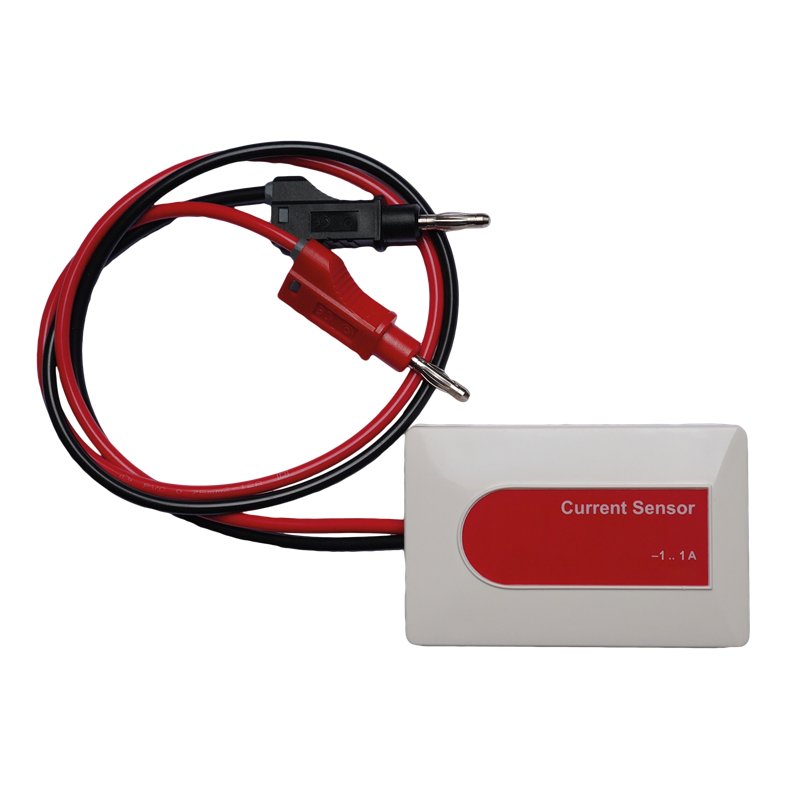

The current sensor is a general-purpose measuring instrument for measuring current in direct and
alternating current circuits. It can be used to measure currents in the range from -1 to +1 ampere.
It is fitted with two banana plugs for easy connection to the test setup.
The sensor features an internal resistor connected between the red and black terminals, which acts as the measuring element.
A small voltage drop occurs across this resistor, which is amplified by a signal amplifier
and transmitted to a connected measurement interface.
The sensor is protected by a multiple fuse. It must be connected in series with a component in the circuit.
Please note that high currents can damage the sensor.
Technical data:
- Measurement range: -1000 to 1000 mA
- Resolution: 0.5 mA
- Max. voltage: 50 V
- Maximum measurement frequency: 100 kHz (CoachLab II+, WiLab) / 1 MHz (VinciLab 2)
Suggested experiments
The current sensor can be used specifically for the precise measurement of electric current in the range from -1 to +1 A –
and is therefore suitable for a wide variety of different experiments.
Examples include:
• Checking the state of charge of a battery or rechargeable battery
• Determining the discharge curve of a capacitor
• Investigating the relationship between current and voltage in various
electrical loads or switching elements: diodes, light bulbs,
light- and temperature-dependent resistors (VDR, LDR, PTC, NTC, etc.)
• Measuring series and parallel circuits
• In conjunction with a voltage sensor, this current sensor can be used to measure
the relationship between current and voltage (Ohm’s Law).